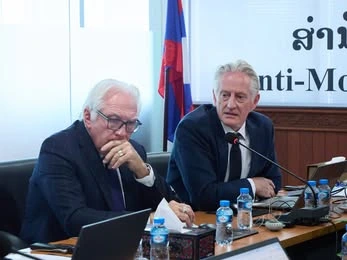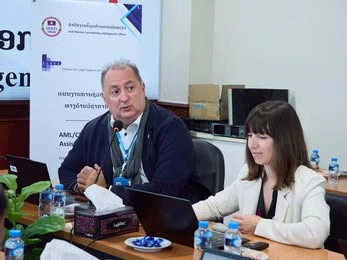
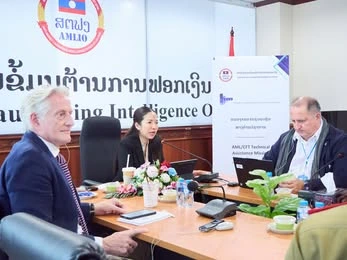
The Anti-Money Laundering Intelligence Office (AMLIO), the United Nations Office on Drugs and Crime (UNODC) and ILSTA held two days of working sessions and consultations in Vientiane to advance the development of Lao PDR’s National Confiscation and Asset Recovery Strategy.
Lao PDR is a jurisdiction under increased monitoring by the Financial Action Task Force (FATF), commonly referred to as being on the “grey list.” FATF sets international standards for combating money laundering and terrorist financing.
Lao PDR must address weaknesses in its systems through a Joint Group Action Plan, whose final deadlines fall in January 2027. Developing a national confiscation strategy is one of its required action items.
The national strategy must set priorities based on the risks Lao PDR faces, define each institution’s responsibilities and establish how authorities will work together. It covers the whole process: finding criminal assets, securing them, managing them and enforcing confiscation decisions.
Confiscation matters because much organised crime is driven by profit. Money from drug trafficking, human trafficking, fraud and corruption allows criminal networks to expand, recruit and bribe officials. Imprisoning offenders can leave their wealth intact and available to their networks. Taking away criminal profits reduces their ability to finance further offences. Recovered assets can also help compensate victims and return stolen public funds, in accordance with the law.
Different measures serve different purposes. Freezing temporarily prevents assets from being moved or sold. Seizure places them under the authorities’ control. Confiscation permanently deprives the owner of those assets through a lawful decision. These measures can cover both criminal profits and property used to commit crimes, including money, houses and vehicles. Proper asset management protects seized property from theft, damage or loss of value while proceedings continue.
Lao PDR must demonstrate that these measures are effective against its national risks. Authorities therefore need to compile accurate, complete and consistent data showing the cases pursued, the crimes involved, the value of assets frozen, seized and confiscated, and the confiscation decisions actually enforced. These figures, supported by concrete case examples, must demonstrate results against the country’s major crime and money laundering risks.
Alongside work on the national strategy, participants examined the draft Decree on freezing, seizure and confiscation, which is intended to support its implementation.
Officials from the Ministry of Public Security, the State Inspection Authority, the Customs and Tax Departments, the Ministry of Justice, the Office of the Supreme People’s Prosecutor, the Supreme People’s Court and the Ministry of Finance participated, together with AMLIO officials and UNODC and ILSTA experts.
This activity was supported by Luxembourg Aid & Development.